
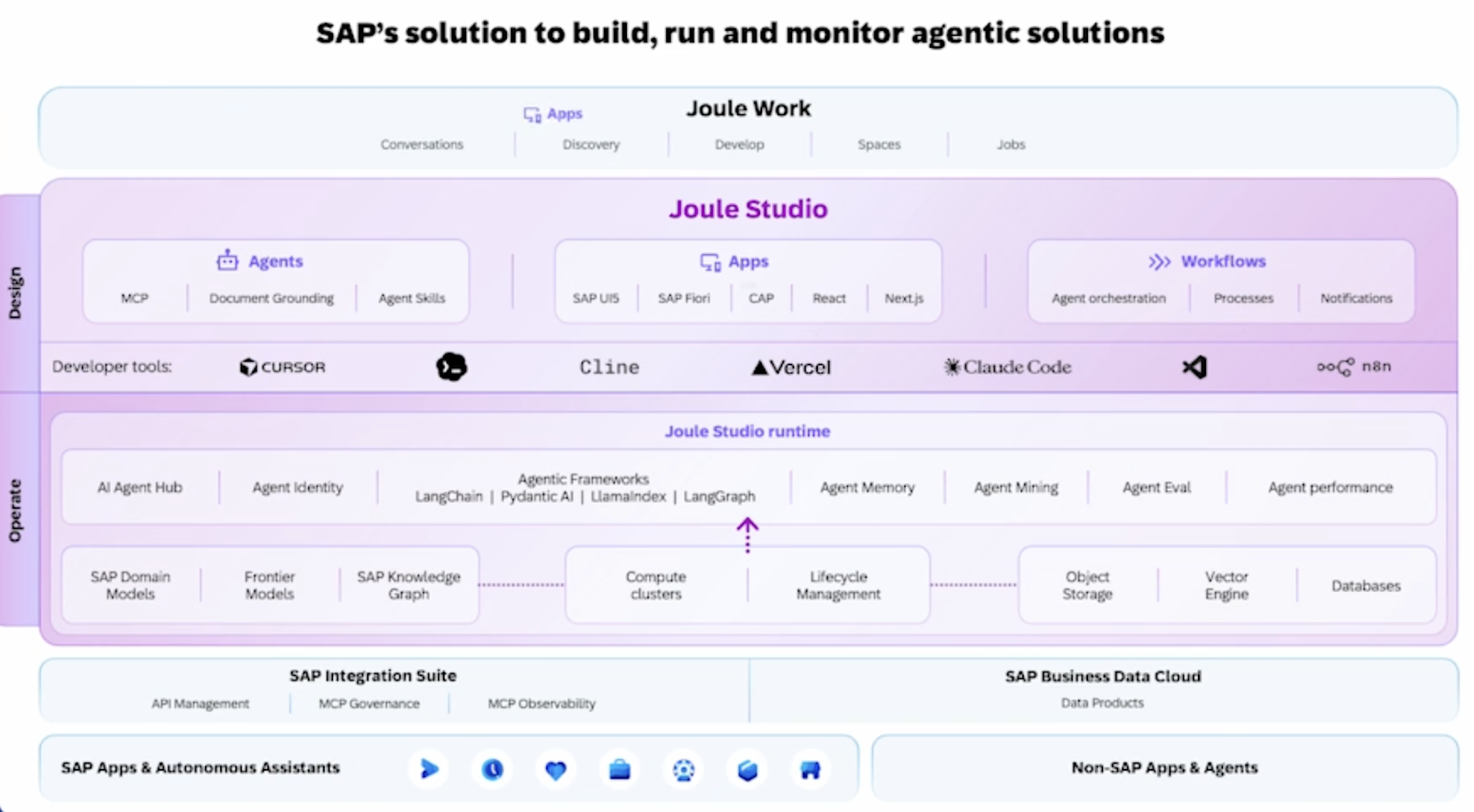
At Sapphire 2026, SAP unveiled the Autonomous Enterprise and a unified SAP Business AI Platform. We break down the architecture, the claims, and where the real work still sits for SAP customers.
SAP Autonomous Enterprise: What the New SAP Business AI Platform Actually Changes
At Sapphire 2026 in Orlando, SAP CEO Christian Klein put a name to where SAP wants to take its customers: the Autonomous Enterprise, where — in his words — „agents run the business and you can focus on what truly matters.“ Behind the slogan sits a genuinely new architecture, the SAP Business AI Platform, that ties together SAP’s data, AI, and application layers into one stack. For SAP customers in the upper mid-market, the interesting question isn’t whether the vision is compelling — it is — but what actually changes operationally, and where the accountability shifts once agents start acting instead of just recommending. That’s what we want to unpack here.
What SAP announced
The announcement was published on news.sap.com on May 12–13, 2026, covering Klein’s keynote in front of roughly 30,000 in-person and virtual attendees.
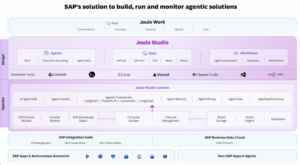
SAP Business AI Platform. A unified architecture merging SAP Business Technology Platform, SAP Business Data Cloud, and SAP’s AI Foundation into three layers: a context layer (SAP Knowledge Graph, SAP Domain Models, and a semantic data layer spanning SAP and non-SAP systems), a build layer (Joule Studio, covering no-code, low-code, and pro-code development), and a governance layer, anchored by the new SAP AI Agent Hub, targeting general availability in Q3 2026 at no additional charge.
SAP Autonomous Suite. Spans five domains — Autonomous Finance, Autonomous Spend, Autonomous Supply Chain Management, Autonomous HCM, and Autonomous CX — orchestrating more than 200 specialized agents and over 50 domain-specific Joule Assistants. One concrete example SAP cites: the Autonomous Close Assistant, meant to compress the financial close from weeks to days.
Joule Work. A new interaction layer across desktop, mobile, and voice, with agentic capabilities including computer and file access, support for open standards (MCP, A2A), and the ability to work across SAP and non-SAP systems — proactively surfacing insights rather than waiting to be asked.
Industry AI. Seven autonomous, sector-specific solutions across 26 industries, including a partnership with RWE aimed at reducing offshore wind turbine downtime.
Financial commitment. SAP is putting €100 million into a partner fund to support agent development and deployment, alongside named technology partnerships spanning Anthropic (Claude is embedded in Joule), AWS, Google Cloud, Microsoft, NVIDIA (which contributed its open-shell framework for agent isolation), Palantir, Accenture, Mistral AI, Cohere, n8n, Parloa, and Conduct.
Customer proof points named by SAP include H&M Group (a Store Intelligence Agent and an AI-powered InStore Concierge), Takeda (up to 10% productivity gains and up to 25% lower revenue loss from stock-outs in regulated manufacturing), and KPMG, which reportedly deployed 20 agents targeting $120 million in contract leakage reduction. These are SAP- and partner-reported figures from the announcement itself, not independently audited results — useful as a directional signal, not as a benchmark to plan against.
On commercial terms: RISE with SAP customers get a contractual commitment to activate three Joule Assistants within the first year, plus a new Max Success Plan; SAP GROW customers get access to 20+ AI assistants from day one, with a stated go-live target of weeks rather than months.
The line SAP itself is drawing: „almost right“ isn’t good enough
The most telling line from the keynote wasn’t a product name — it was Klein’s framing of the accuracy bar: „For the mission-critical processes of our customers, ‚almost right‘ just isn’t good enough.“ A related line from the same event went further: „Eighty percent is just not good enough when you run… business-critical businesses. They should not guess; they should deliver accurate, compliant, and secure outcomes.“
That’s SAP naming, in public, exactly the risk that comes with moving from AI-assisted work to AI-executed work. It’s also why the governance layer — the AI Agent Hub — sits alongside the build layer as a first-class part of the architecture rather than an afterthought, and why NVIDIA’s open-shell isolation framework is positioned as core infrastructure, not an add-on.
What it means for SAP operators
For a SAP landscape that’s grown over a decade or more, three things follow from this shift.
First, orchestration complexity moves from „does agent X work“ to „do 200+ agents interacting across five domains behave predictably together.“ That’s a materially different testing problem than validating a single automation — it’s an integration and regression problem at platform scale, and it doesn’t go away because each individual agent was validated in isolation.
Second, the context layer’s promise — a semantic layer spanning SAP and non-SAP systems — is only as good as the domain models and data quality underneath it. For most gehobener Mittelstand landscapes, that data foundation work predates any agent rollout and is usually the actual bottleneck, not agent availability.
Third, the commercial commitments (three assistants in year one under RISE, 20+ under GROW) mean the adoption clock starts running whether or not the governance model is ready. That makes the AI Agent Hub’s permission and audit model something to define early, not something to retrofit after the first assistants are live.
Our take
The Autonomous Enterprise vision is coherent, and the architecture behind it — context, build, governance as three explicit layers — is a more disciplined structure than SAP’s previous AI messaging. The part worth treating with healthy skepticism isn’t the vision, it’s the gap between „agents deployed“ and „agents trusted with mission-critical decisions,“ which is exactly the gap SAP itself is naming when it says 80% accuracy isn’t good enough. Closing that gap isn’t a configuration task — it’s an ongoing evaluation and testing discipline, especially once agents span 200+ specialized functions instead of one well-scoped process.
For SAP customers weighing RISE or GROW commitments against this roadmap, we’d recommend treating the AI Agent Hub’s governance model and an independent evaluation framework for agent accuracy as prerequisites, not follow-up work — particularly given that both RISE and GROW start the assistant-activation clock from day one. That’s precisely the intersection of SAP Business AI and agentic testing we work in: if you want a second opinion on what „ready for autonomous agents“ actually looks like for your landscape, get in touch.

Ein Kommentar
Hi, this is a comment.
To get started with moderating, editing, and deleting comments, please visit the Comments screen in the dashboard.
Commenter avatars come from Gravatar.