SAP Joule Studio and SAP LeanIX: Why Your Agents Need an Architecture Map
With the relaunch of Joule Studio at SAP Sapphire 2026, SAP made agent development a lot easier: intent-based development, pro-code and low-code paths, an embedded n8n canvas and a managed runtime. What gets less attention is the other half of the story. Building an agent is one problem. Knowing which applications, interfaces and business capabilities that agent touches, who owns it, and whether it should still be running in six months is a different one. SAP’s answer to that second problem is SAP LeanIX. For teams running SAP landscapes, the interesting question isn’t whether the two products are connected. It’s where that connection already exists and where it’s still mostly slideware. That’s what we want to unpack here.
What was announced
Both announcements landed on May 13, 2026, at SAP Sapphire in Orlando. Taken together, they describe three touchpoints between Joule Studio and SAP LeanIX.
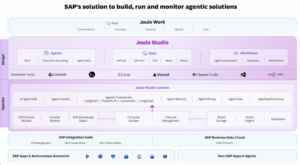
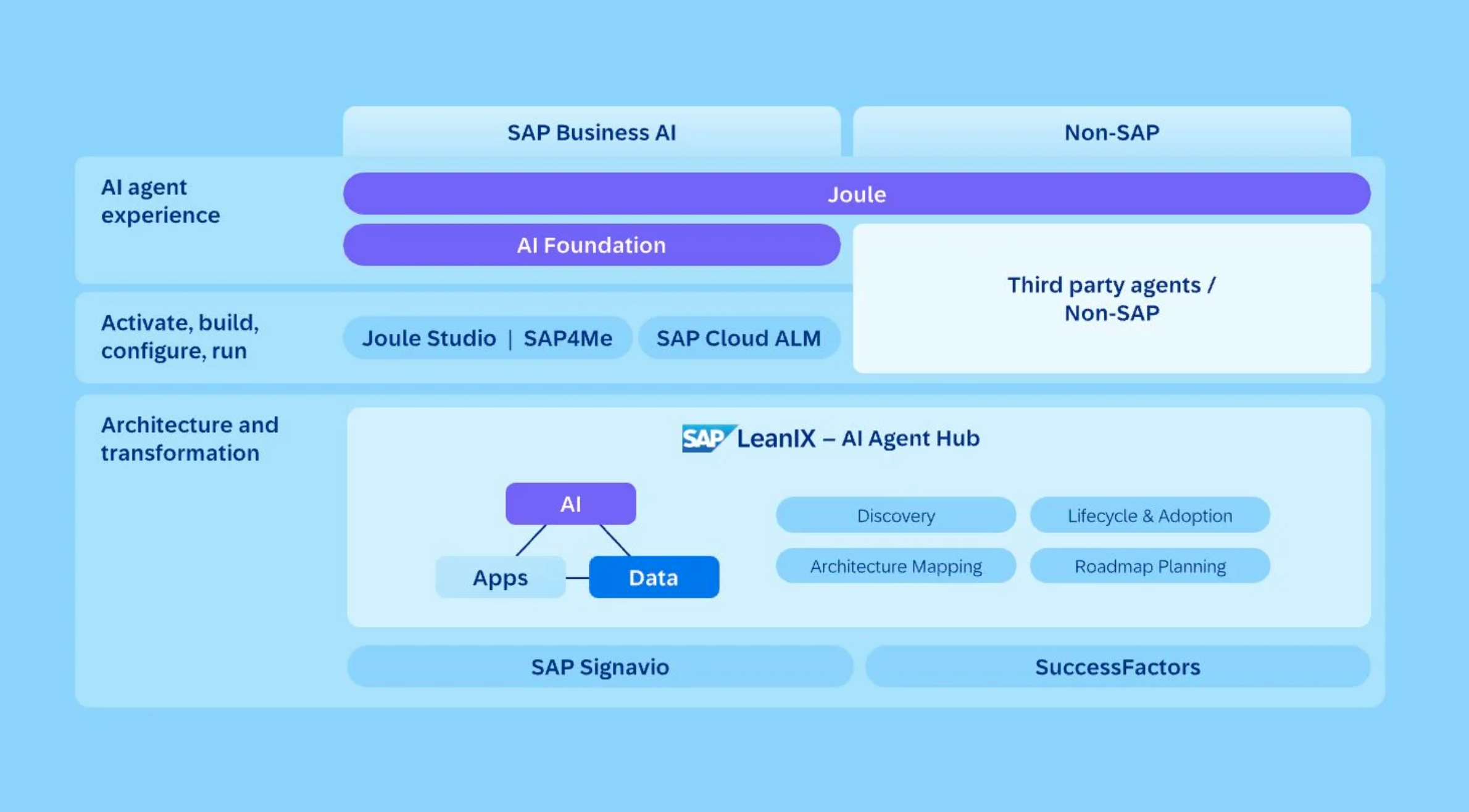
LeanIX as design-time context. SAP’s reference architecture for building agents with Joule Studio names SAP LeanIX as one of three grounding sources for intent-based development, alongside the SAP Knowledge Graph and the Generative AI Hub. LeanIX supplies the enterprise landscape context: applications, business capabilities and organizational structure. The idea is that an agent specification generated from a business intent is grounded in your landscape, not in a generic SAP reference model.
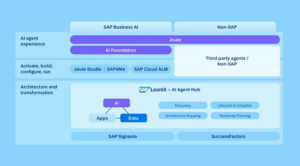
LeanIX as the governance layer for agents. SAP AI Agent Hub, an optional capability within SAP LeanIX Application Portfolio Management, discovers agents across platforms, including pre-built and custom agents on Joule Studio, as well as Google Agent Engine and agents registered in Microsoft Entra ID (Copilot Studio, Azure AI Foundry). Agents are modeled as a subtype of application, so they appear in the same inventory as the systems they depend on, with lifecycle, ownership and approval status. According to SAP, more than 180 organizations had discovered around 180,000 agents in production through the hub by Sapphire 2026.
LeanIX data as a tool for agents. The MCP server for SAP LeanIX has been generally available since November 2025 and exposes fact sheets, quality seals, tags and portfolio data to AI agents. SAP reports more than 200 customers using it. At Sapphire, SAP LeanIX added packaged MCP Apps for common EA workflows, listed as compatible with Claude, Microsoft Copilot and SAP Joule, plus an open-source repository of pre-built agents and skills.
Commercial framing. SAP is offering free design-time access to Joule Studio, including AI-assisted development within fair-use limits, through the end of 2026. SAP AI Agent Hub, by contrast, is licensed as an add-on to LeanIX Application Portfolio Management. Teams that want the governance half of the story need a LeanIX APM subscription first.
The nuance worth noting: context and control are two different integrations
It’s easy to read „Joule Studio integrates with SAP LeanIX“ as a single feature. It isn’t. The design-time grounding, the agent inventory in AI Agent Hub and the MCP-based data access are three separate mechanisms with different maturity levels and different prerequisites.
That matters because the value of the grounding depends entirely on the quality of your LeanIX data. An agent specification that is „grounded in your landscape“ is only as good as the fact sheets behind it. If application owners, interface relationships or lifecycle dates in LeanIX are stale, the agent is designed against a landscape that doesn’t exist, and nothing in the development flow will flag that.
The same applies in reverse on the governance side. AI Agent Hub tells you that an agent exists, who owns it and whether it’s approved. It does not tell you whether the agent behaves correctly against your SAP processes. Inventory is not verification.
What it means for SAP operators
For teams already running LeanIX, or evaluating Joule Studio as their agent platform, three things follow.
First, treat your LeanIX data quality as a prerequisite for agent development, not a side project. Before the first Joule Studio agent is specified against your landscape, check the fact sheets it will be grounded in: application-to-capability mapping, interfaces to the S/4HANA core, owners and lifecycle status. LeanIX’s own quality seals and completeness indicators are the obvious starting point.
Second, register agents in the inventory from day one. The cost of adding an agent to AI Agent Hub when it is built is low. The cost of discovering fifty undocumented agents a year later, some of them touching finance or procurement data, is not. Discovery for Joule Studio agents is built in, but ownership, business capability mapping and approval status still need a person to maintain them.
Third, use the landscape model to scope testing. If LeanIX knows which applications, interfaces and capabilities an agent touches, that is exactly the input needed to decide which end-to-end scenarios have to be tested before go-live, and which regression tests need to run when one of those systems changes. An agent that reads from S/4HANA, writes to a third-party system and routes approvals through a human checkpoint has a test scope that the architecture map can make visible, as long as someone actually derives it.
Our take
Connecting Joule Studio to SAP LeanIX is the right move. Agents are going to become part of the application landscape, and treating them as governed architecture objects rather than as individual automation projects is the only approach that scales past the first dozen. SAP is in a strong position here because it owns both the build environment and the EA repository.
The part we’d treat carefully is the assumption that the integration does the work for you. The grounding needs clean architecture data, the inventory needs owners who maintain it, and neither replaces scenario-based testing of what the agent actually does against real SAP processes. For teams starting with Joule Studio in 2026, we’d recommend using the free design-time period for exactly that: bring LeanIX data up to a usable standard, define how agents get registered and approved, and build the test scope from the landscape model before the first agent goes near production.
If you’re planning agents in Joule Studio and want a second opinion on whether your LeanIX landscape is ready to ground them, or on where the testing burden sits before go-live, get in touch. That’s the gap between „governed on paper“ and „production-ready“ we work on.