SAP now frames S/4HANA migration as the entry ticket to the Autonomous Enterprise. We separate the real deadline pressure from the parts of the vision that are still genuinely undefined.
SAP S/4HANA: The Journey to the Autonomous Enterprise
SAP has stopped talking about the S/4HANA migration and the Autonomous Enterprise as two separate topics. Since Sapphire 2026, the message has been that S/4HANA Cloud with RISE with SAP is one of exactly three foundational platforms the whole autonomous vision sits on — alongside Joule and SAP Business Technology Platform. For SAP customers in the upper mid-market still weighing their ECC migration path, that reframing changes the calculus: the migration decision is no longer just about staying supported, it’s being positioned as the entry ticket to everything SAP is building next. We think that framing is mostly right, but not fully earned yet — here’s the distinction worth drawing.
What SAP says the foundation looks like
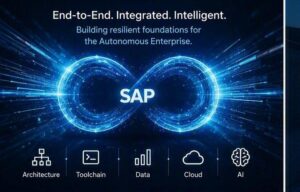
SAP SVP Sergio Maccotta defined the Autonomous Enterprise, in coverage of SAP’s regional Q2 2026 momentum, as „a business capable of sensing change, making decisions, and acting with minimal human intervention.“ SAPinsider’s framing of the same message names the three platforms SAP positions as load-bearing: SAP S/4HANA Cloud with RISE with SAP as the core transactional layer with upgrade stability, Joule as the generative AI copilot layer, and SAP Business Technology Platform as the integration and data management layer underneath both. Autonomous operations are described as already deployed across finance, supply chain, HCM, and industry processes in energy, retail, and manufacturing — with 2026 characterized as the year self-optimizing systems start separating „the most resilient and profitable businesses from the rest.“
One detail from that coverage is worth taking seriously rather than treating as boilerplate: data governance and security are explicitly called „non-negotiable pre-requisites,“ not follow-on activities — the argument being that AI-driven actions need to inherit ERP authorization, data lineage, and compliance controls from day one, not have them retrofitted after agents are already acting.
The forcing function: ECC’s maintenance clock
The part of this story that isn’t marketing framing is the maintenance timeline, and it’s worth being precise about it because the dates differ by release. For ECC 6.0 on Enhancement Packages 0–5, mainstream maintenance ends at the close of 2026; for EHP 6–8 — the base most upper-mid-market customers actually run — mainstream maintenance runs through the end of 2027, with optional, chargeable extended maintenance available through the end of 2030 (at a stated two-percentage-point surcharge). SAP has also introduced an „SAP ERP, Private Edition, Transition Option“ that extends support to 2033 — but only for customers committing to the RISE with SAP cloud subscription model and running (or migrating to) HANA as their database, so it’s a bridge toward cloud, not an alternative to it. Separately, and already in effect: as of May 31, 2026, most on-premise SAP S/4HANA customers lost access to Compatibility Packs, with the exception extended to RISE with SAP and SAP Cloud ERP Private Edition customers through the end of 2030.
Read together, these dates do the actual work that „join the Autonomous Enterprise“ framing gets credit for: they’re what forces a migration decision inside a fairly tight window, RISE with SAP is the path SAP has built the longest runway around, and RISE with SAP happens to be the same platform SAP names as the autonomous vision’s transactional foundation. The deadline pressure is real and independently verifiable; the positioning of RISE as the autonomous on-ramp is SAP’s commercial framing layered on top of it.
Where the vision still gets ahead of the product
A more skeptical read from SAPinsider, published shortly after the Sapphire announcements, lists a set of open questions that are worth treating as a checklist rather than dismissing as launch-week nitpicking. Pricing is undefined — per-user, per-agent, per-transaction, or token-based, and which Joule capabilities are included in a base subscription versus billed separately isn’t specified. Of the 200-plus agents SAP has announced, which are generally available today versus roadmap items isn’t consistently clear. There’s no defined prerequisite sequence for S/4HANA Cloud, Clean Core, and Joule adoption — meaning „what order do we actually do this in“ is left to the customer and their implementation partner to work out. And the governance mechanics that SAP itself calls non-negotiable — segregation-of-duties enforcement when an agent acts autonomously, audit trail detail, cross-platform integration behavior — aren’t documented in the depth a compliance or internal-audit function would need before signing off.
None of that means the vision is wrong. It means the vision and the shippable, priced, governable product are running on different timelines, and a migration business case built on the full autonomous promise is borrowing against capability that isn’t fully specified yet.
Our assessment
We’d separate this into two decisions that shouldn’t be made as one. The migration decision — leave ECC before the end of 2027 (or 2030/2033 under the specific conditions above) — is a deadline-driven decision with real, dated consequences for staying put, and it should be made on that basis: cost of extended maintenance, availability of migration consultants (a shortage that multiple sources expect to push daily rates up materially after 2027), and your own system’s fit for RISE versus a private cloud or on-premise path. That case stands on its own without needing the Autonomous Enterprise vision to justify it.
The autonomy adoption decision — how far into agentic finance, supply chain, or HCM processes you go, and on what timeline — is a separate decision that should wait on the governance model SAP itself says is a prerequisite, not a decision to bundle into the migration business case to make the ROI numbers look better. In practice, that means treating Clean Core discipline and a defined authorization/audit model for AI-driven actions as gating work before the first autonomous process goes live, not as something you’ll figure out once the agents are already running finance close or supplier approvals. The customers best positioned for 2027 won’t be the ones who moved fastest on both fronts at once — they’ll be the ones who used the migration’s forced timeline to get the RISE foundation and Clean Core discipline right, and treated the autonomous layer as a second, deliberately sequenced decision on top of it.
If you’re weighing your own ECC exit timeline against how much of the autonomous roadmap to commit to now, we’d be glad to help separate the two — that’s exactly the kind of SAP toolchain and governance sequencing question we work on.